
Dramatization
The grid goes dark. Your house does not have to.
Hour 0. A closed fridge keeps food safe for about 4 hours. Every person needs a gallon of water a day. One free two-page list carries your family through the first 72 hours.
Not on sale yetEbook $7.99Complete Bundle $14.99
Free PDF, 2 pages. It downloads right away. No email needed. Read page 1 first
The next 72 hours, scene by scene
What a blackout does to an ordinary home, what a ready family is doing at that moment, and the line on the free checklist that covers it.
-
Hour 0 H+00
The lights cut out. So do the card readers.
After Hurricane Helene, many of the stores that could open in western North Carolina took cash only, and most ATMs were down or empty. Source: Carolina Public Press
Inside the ready house. Headlamps on, a battery lantern on the table, everyone counted. Small bills are already in the drawer.
On the free checklist
- LED flashlight. 1 per person. For 2: 2. For 4: 4.
- Cash in small bills. ATMs and cards may not work.
-
Hour 4 H+04
The refrigerator goes quiet. The clock on your food starts.
A closed refrigerator keeps food safe for up to 4 hours without power. A full freezer holds for about 48. Perishable food that sits at 40°F or warmer for 2 hours goes in the trash. Source: USDA Food Safety and Inspection Service
Inside the ready house. The fridge door stays shut. Dinner comes off the shelf: canned meals and a manual can opener, no stove needed.
On the free checklist
- Ready-to-eat canned meals. 1 person: 6 cans. For 2: 12. For 4: 24.
- Manual can opener. 1 per home.
-
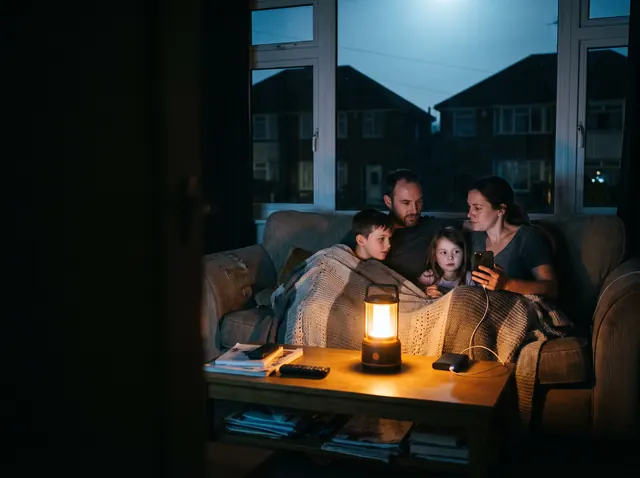
Hour 12 H+12
Night one. Phones fade, and the network can drop with them.
On September 28, 2024, after Hurricane Helene, 74 percent of cell sites in the storm-hit counties of North Carolina were out of service. Source: Congressional Research Service
Inside the ready house. One phone charges at a time from the power bank. The numbers that matter are on a paper card.
On the free checklist
- Phone power bank, charged. 1 per home to start.
- A written contact card in every wallet and backpack.
-
Hour 24 H+24
Every person has needed a gallon of water.
In the 2003 blackout, witnesses told Congress, Detroit's water pumps lost power and four million customers lost drinking water. Source: Ready.gov, U.S. House hearing record
Inside the ready house. They drink from jugs filled weeks ago, counted at a gallon per person per day.
On the free checklist
- Drinking water. 1 person: 3 gal. For 2: 6 gal. For 4: 12 gal.
-
Hour 72 H+72
Day three. The power may still be out.
In Texas in February 2021, more than 4.5 million people lost power, some for as long as four days. Source: FERC and NERC final report
Inside the ready house. Still on the list: water, food, light, medicine and cash, ticked off long before tonight.
On the free checklist
- The whole list. Most of this costs about $50 for two people.


Every scene ends at the same table.
Water, canned food, a light, batteries, a can opener and a first-aid kit. The checklist says most of it costs about $50 for two people, and you tick off what is already in your kitchen before you buy anything.
Free PDF, 2 pages. It downloads right away. No email needed. Read page 1 first
One street, one lit house
A short film about the night the power goes out, and the house that got ready on an ordinary Saturday. Sound starts only when you press play. Captions are on.
- Running time
- 0:52
- Captions
- English
Why now
The next outage will not send a warning first.
Outages are lasting longer, and about half of U.S. adults do not feel prepared. The families who get through one calmly are the ones who prepared on an ordinary day. Today can be that day, for you and the people you live with.
- 11 hours
The average time a U.S. customer went without power in 2024, nearly twice the yearly average of the decade before.
Source: U.S. Energy Information Administration - 51%
The share of U.S. adults who said they believed they were prepared for a disaster. The other half were not sure or knew they were not.
Source: FEMA, 2023 National Household Survey - Several days
How long Ready.gov says your household may need to manage on its own after an emergency.
Source: Ready.gov, Build a Kit
What would you do first?
Four things decide how the first 72 hours go. Pick one to see the first action, what it takes and the page that covers it.
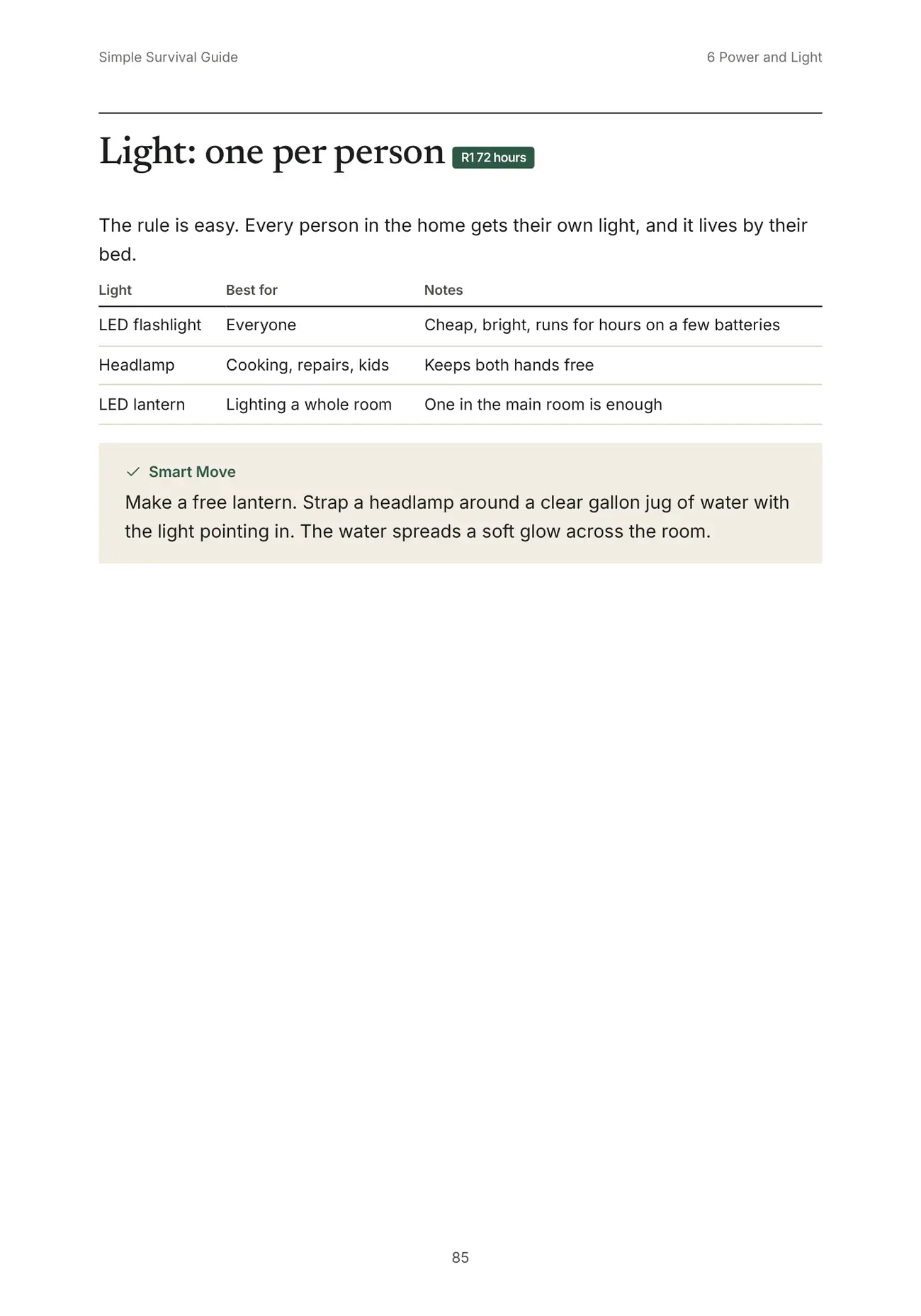
Light · The first minute
Put a light in every hand.
Skip the candles. The Red Cross says to use flashlights instead, because candles start fires. Give each person a battery flashlight or headlamp, and stand one battery lantern where the family gathers. Keep them where you can find them in the dark.
- What it takes
- One LED lantern for the room, $10 to $25, and one LED headlamp per person, $8 to $20 each.
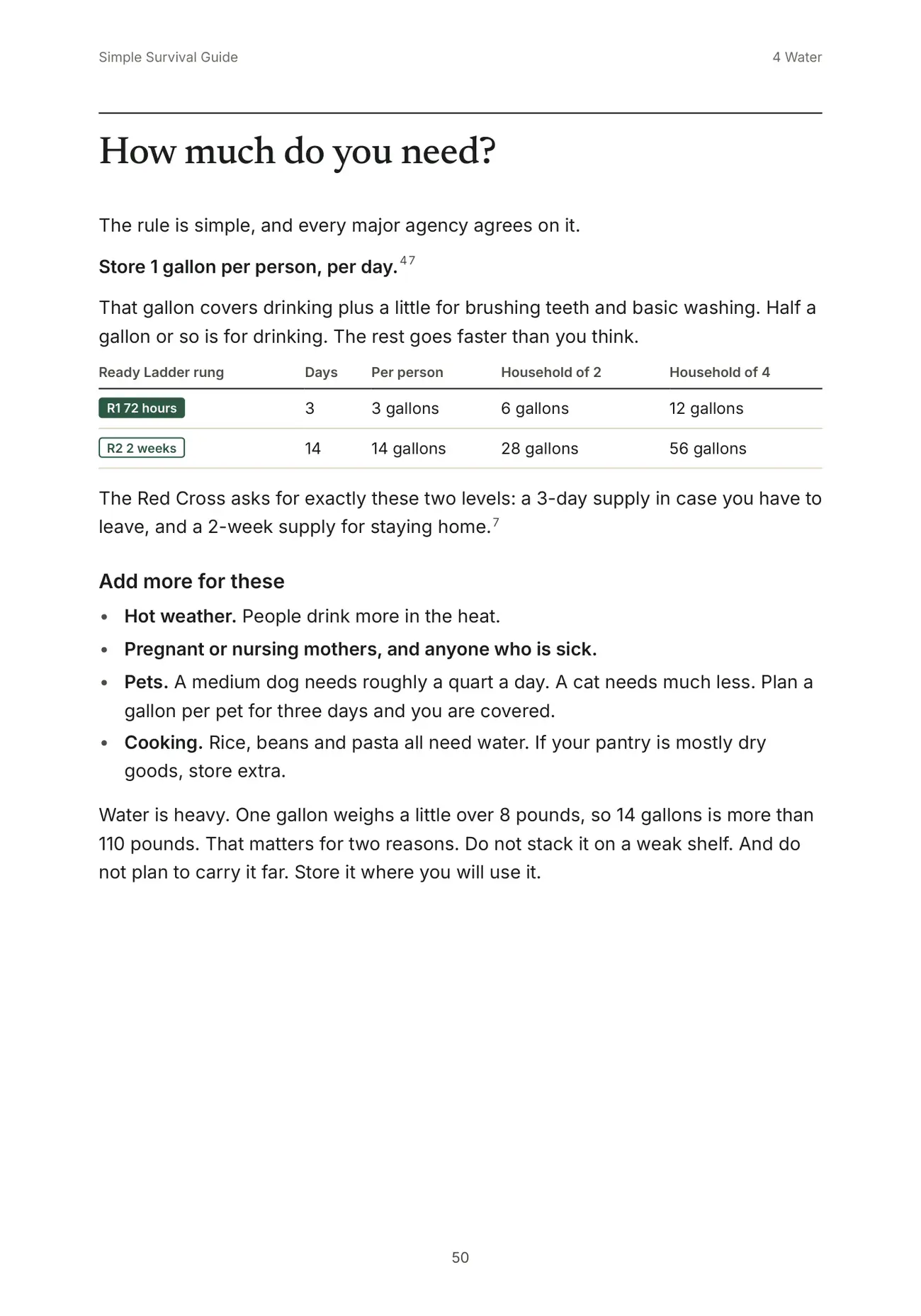
Water · The first hour
Count your water before you need it.
Plan on one gallon per person, per day: three gallons each for 72 hours. Fill clean containers while the tap still runs, because the pumps that move city water can lose power too. Write the total on the plan.
- What it takes
- Clean 2-liter soda or juice bottles filled with tap water: free, at home. Refill them every 6 months.
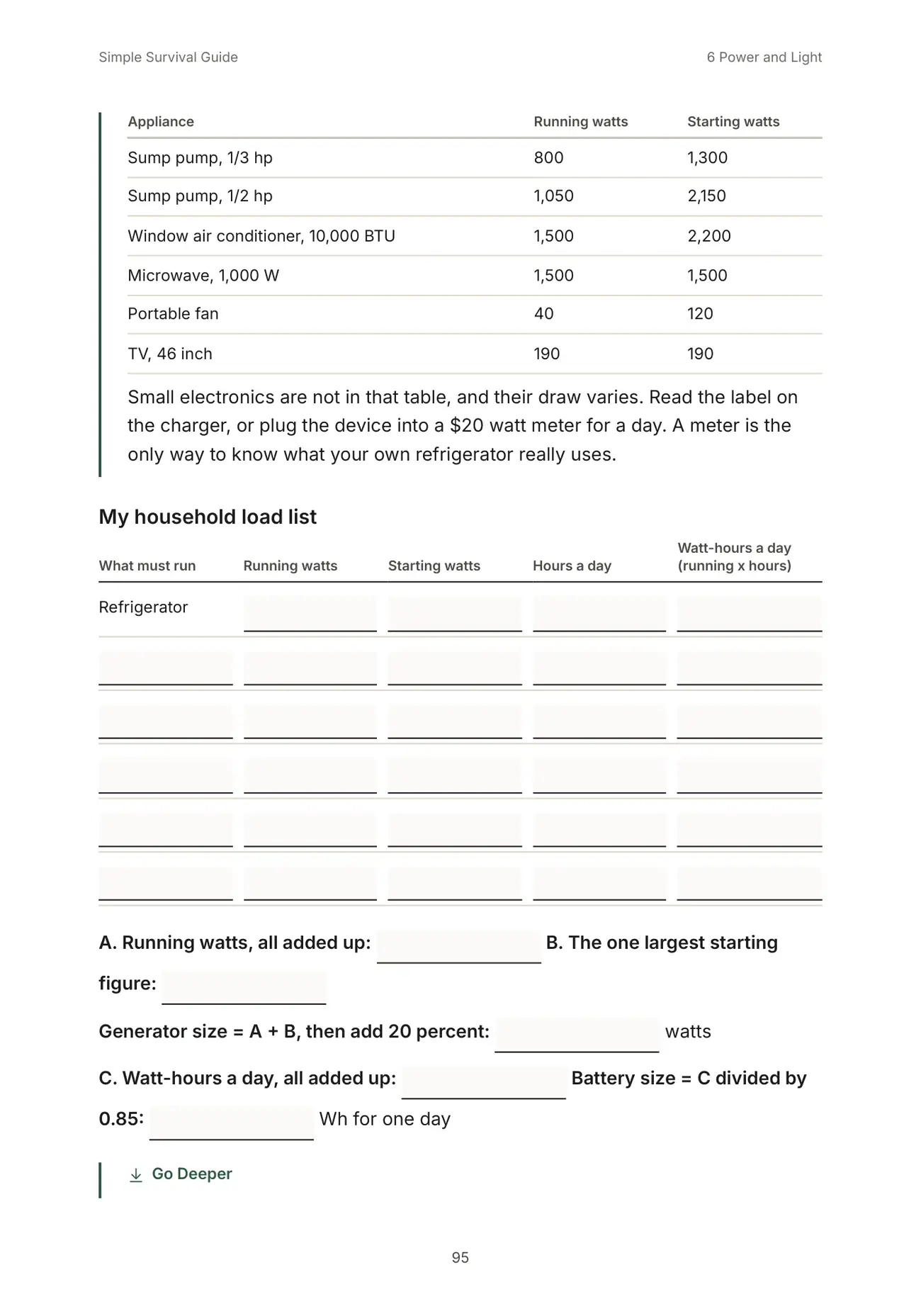
Power · The first night
Decide what gets the battery.
Phones run down first. Charge a power bank today, then list what must run in an outage and how many watts each thing draws. That list decides the size of any battery or generator before you buy one. A fuel generator only ever runs outdoors, at least 20 feet from windows and doors, and never in a garage.
- What it takes
- A phone power bank, 10,000 mAh: $15 to $25. Anything larger waits for the load list.
Family plan · The first day
Write down who to call and where to meet.
Cell networks can fail with the power, and a text often gets through when a call does not. Put the phone numbers on paper, pick one meeting place near home and one out of the neighborhood, and agree on one out-of-town contact everyone can reach.
- What it takes
- A printed contact card in every wallet and backpack: free.
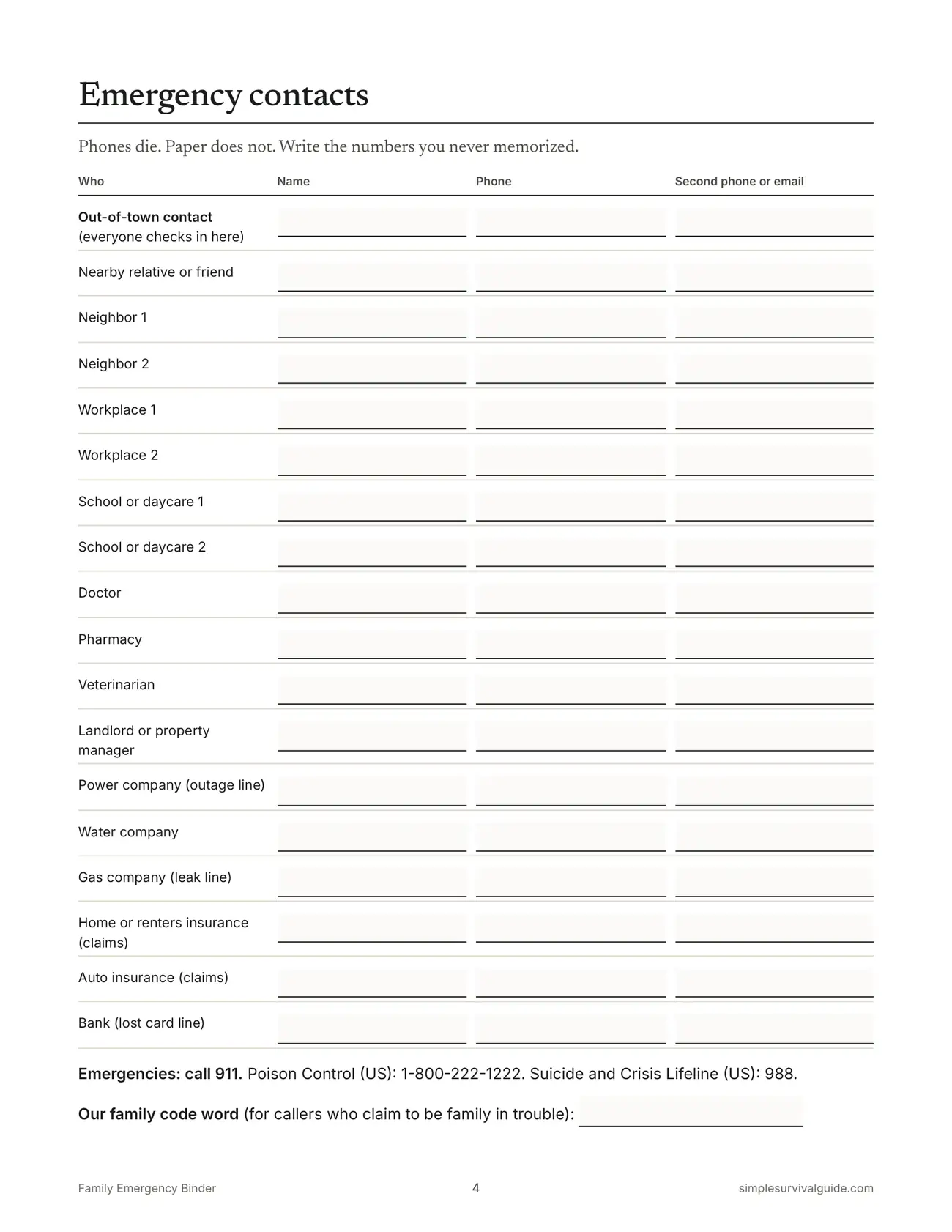
Read three real pages first
Each is a page from the files you download, with its lines copied beside it.
-
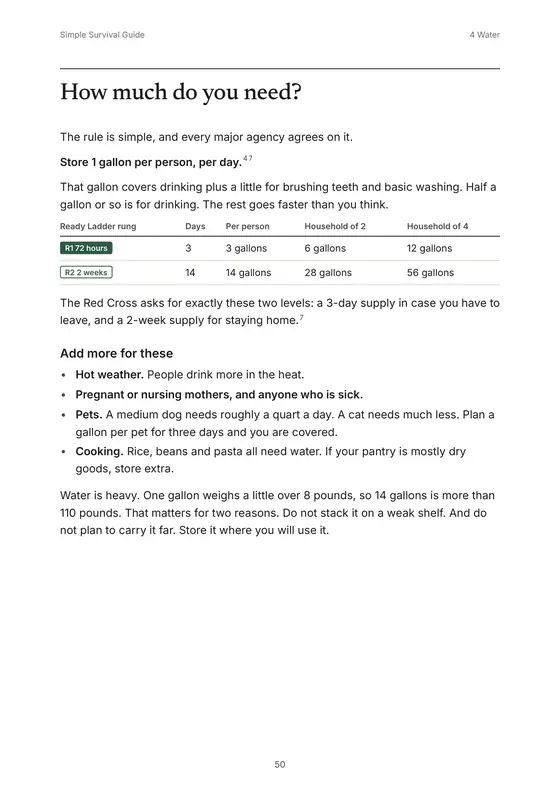
How much water to store
The guide, chapter 4, page 50 of 368.
- Two weeks14 gallons each. 28 for 2. 56 for 4.The Red Cross asks for a 2-week supply for staying home.
- PetsA medium dog needs roughly a quart a day. A cat needs much less.Plan a gallon per pet for three days and you are covered.
- Water is heavyOne gallon weighs a little over 8 pounds, so 14 gallons is more than 110 pounds.Do not stack it on a weak shelf. Store it where you will use it.
-
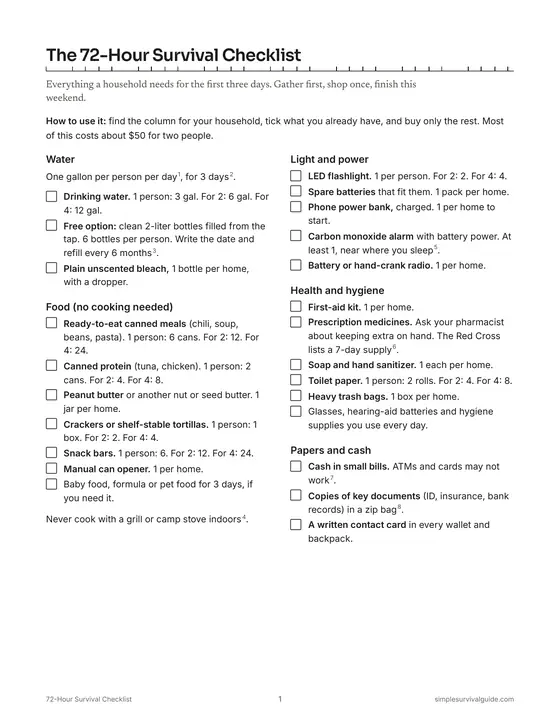
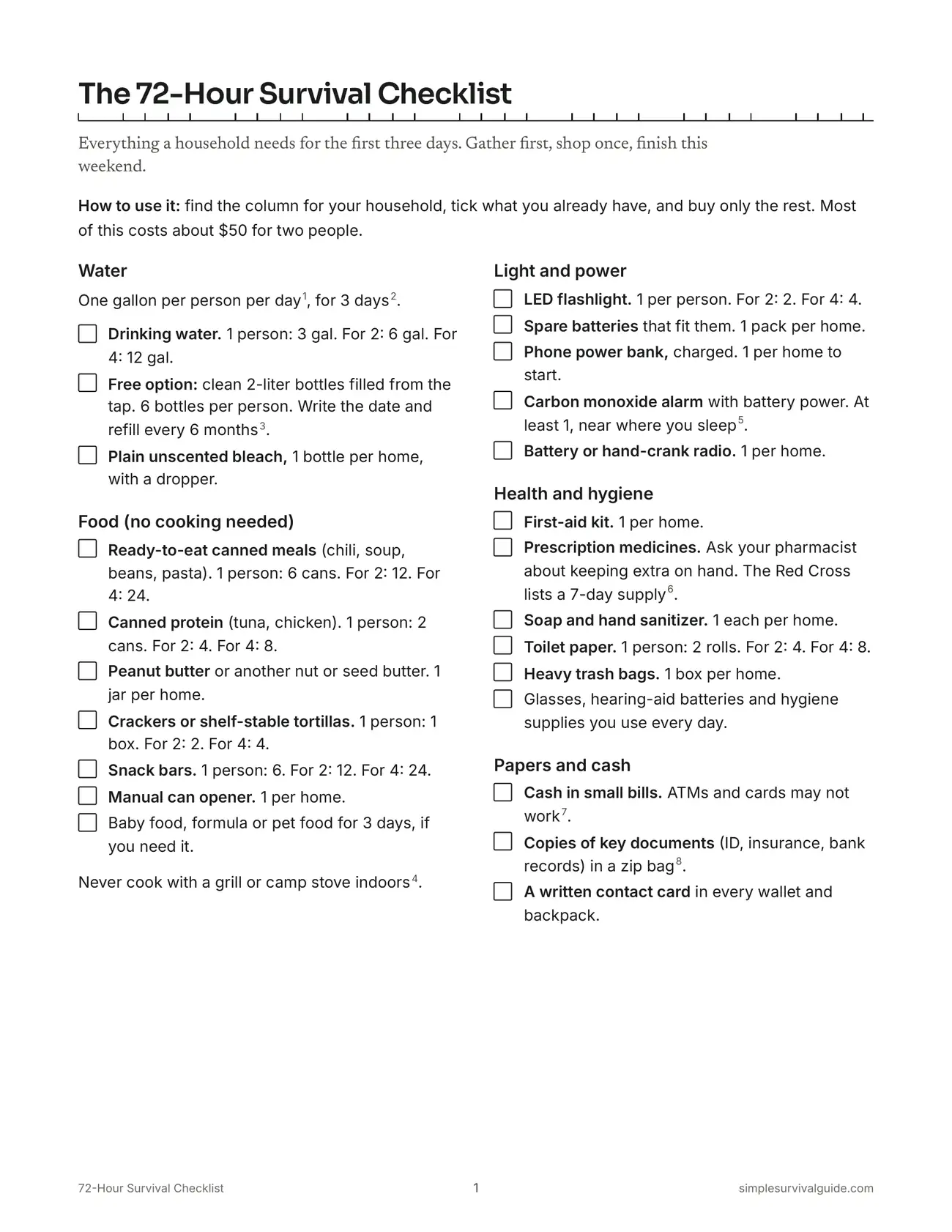
The free 72-hour checklist
Free download. Page 1 of 2.
- Canned protein1 person: 2 cans. For 2: 4. For 4: 8.Tuna or chicken. No cooking needed.
- Carbon monoxide alarmAt least 1, near where you sleep.With battery power. Never cook with a grill or camp stove indoors.
- Copies of key documentsID, insurance, bank records.In a zip bag.
-
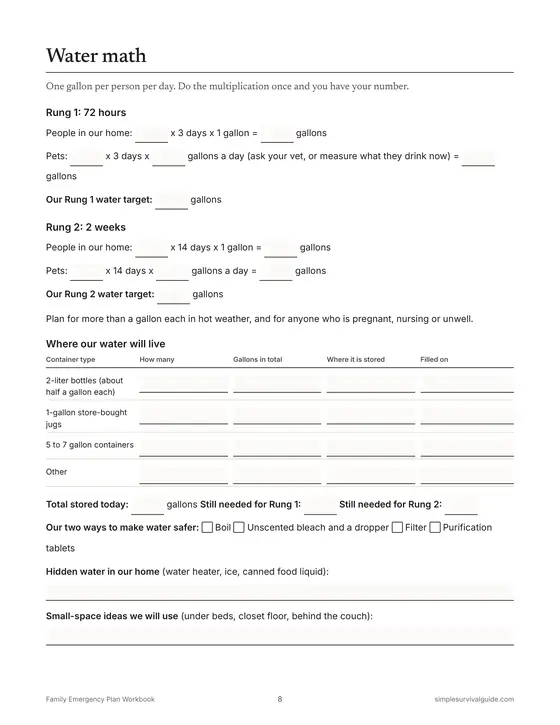
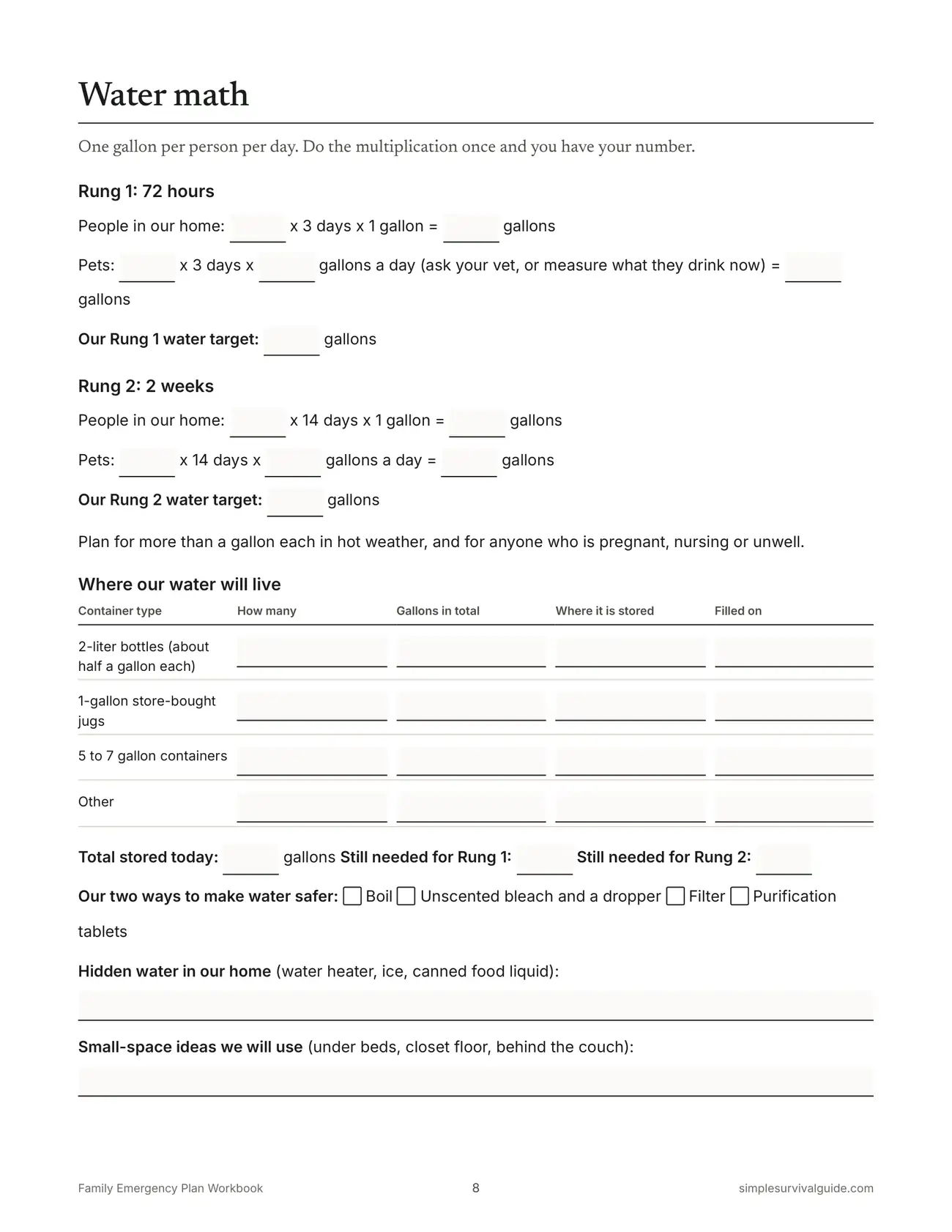
Water math worksheet
Family Emergency Plan Workbook, page 8 of 28. In the Complete Bundle.
- Rung 1: 72 hoursPeople in our home: x 3 days x 1 gallon = gallons
- Our Rung 1 water target: gallons

Five things done by Sunday night
The guide starts with one weekend, in this order.
Store three days of water
Three gallons per person, in containers you own, each dated.
Pack a three-day food box
No-cook food you already eat, mostly from your pantry.
Put a light by every bed
One flashlight or headlamp each, and a way to charge a phone.
Write the family plan
Contact cards, an out-of-town contact and two meeting places, on paper.
Make one short shopping trip
Gather from home first, then buy only what is missing.
Read on screen, write on paper
The guide is a PDF and an EPUB. The checklists, workbook and binder are fillable PDFs laid out for black-and-white printing.
- Format
- PDF and EPUB. Fillable PDFs for the sheets.
- Length
- 20 chapters. 368 pages in English, 409 in Spanish.
- Languages
- English and Spanish editions.
- Printing
- US Letter, black and white, for your own household.
- Delivery
- Digital download. Nothing ships.
See all 20 chapters
- Start HereThe Ready Ladder, your first Ready Score and a 7-day plan
- The Domino MapHow one failure spreads, and how to stop it
- Your Risk MapWhat is likely where you live
- WaterHow much, where to store it, how to make it safe
- Food72 hours, 2 weeks and 3 months from a normal grocery store
- Power and LightOutage plan, batteries, solar and generator safety
- Keep It ColdRefrigerator, freezer and cold medicine, hour by hour and for a week or more
- CommunicationsContact cards, meeting places, radios and satellite
- MoneyCash, card outages, documents, scams, barter basics
- Health, First Aid and SanitationKit, medicines plan, hygiene, a toilet without running water
- The Bug-In PlaybookStaying home safely, scenario by scenario
- The Bug-Out PlaybookWhen to leave, go-bags, car kit, routes
- AI, Cyber and Digital DisruptionOffline copies and a family offline mode
- Special SituationsRenters, kids, seniors, disabilities, pets, away from home
- Grow and PreserveContainer gardening, sprouting, reading labels
- Your Ready CircleNeighbors, family and a 5-household check-in plan
- Budget BuildsComplete lists at $50, $100, $500 and $2,000
- Your Offline Survival LibraryWhat to print and the family emergency binder
- Your 30-Day Ready PlanOne small action a day, then a 90-day re-check
- Quick-Reference Cheat SheetsOne-page tables for the fridge door
Two editions, both digital
Pay once in US dollars, download and keep the files. Neither is on sale yet.
| What you get | Ebook | Complete Bundle |
|---|---|---|
| The guide: 20 chapters, PDF and EPUB | One language | English and Spanish |
| Printable Checklist Pack, 59 fillable pages | Not included | Included |
| Family plan workbook and emergency binder | Not included | Included |
| Regular price (USD) | $7.99Not on sale yet | $14.99Not on sale yet |
| Details | About the ebook | About the bundle |
We recommend the bundle if more than one person will use the plan, or if you want pages to print and fill in.
$7.99 is the regular price. A $5.99 launch price runs for the first 14 days once sales open. The Printable Checklist Pack on its own: $3.99 USD.
What people ask first
Is anything shipped to me?
No. Every product on this site is a digital download. When the guide goes on sale, you will get the files right after checkout. Nothing arrives by mail.
Which language do I get?
The ebook will be sold in English or in Spanish, and you will choose one at checkout. The Complete Bundle and the Printable Checklist Pack include both languages.
Does the price include the supplies?
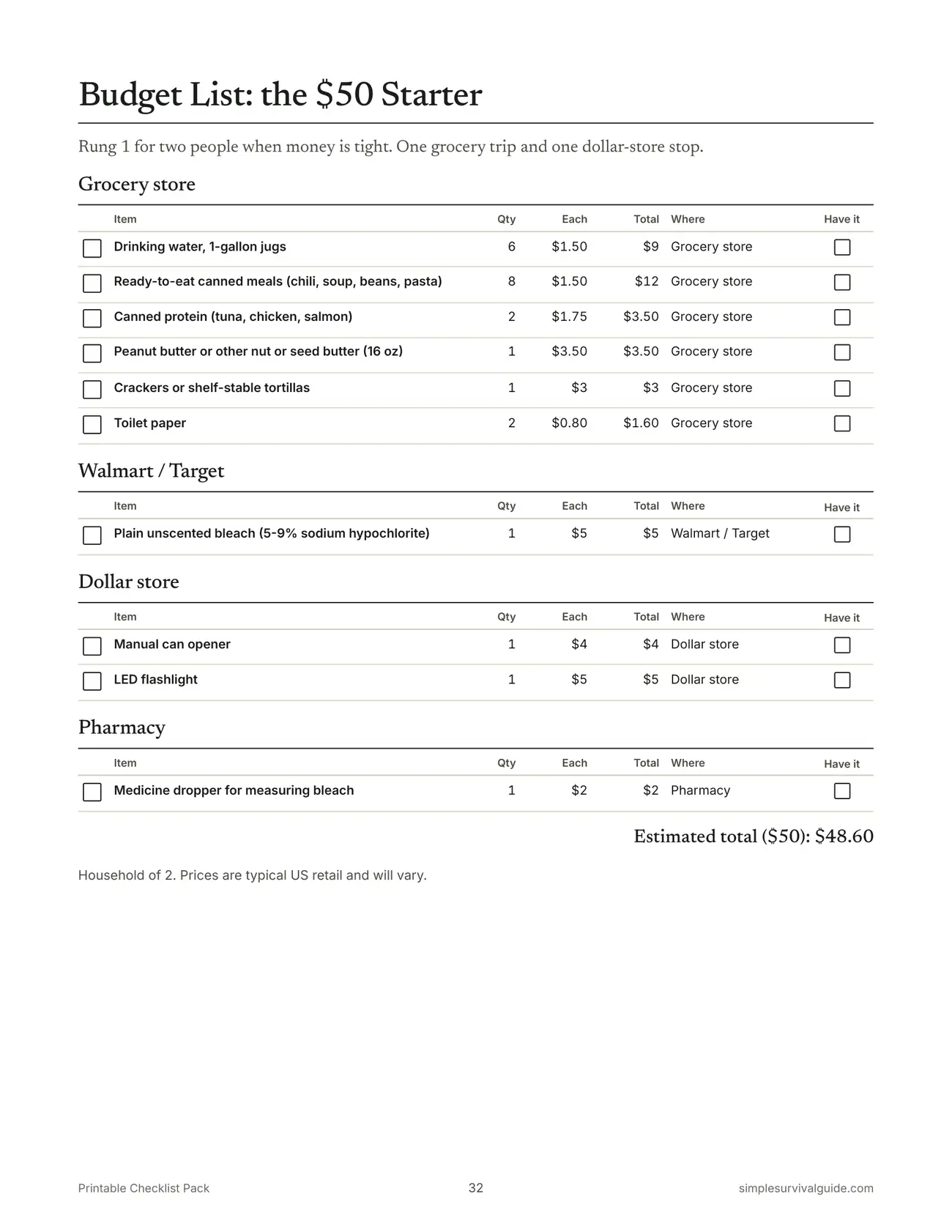
No. The price is for the guide. You buy supplies separately, wherever you shop. The guide's starter list for a household of two totals $49.55 at typical US retail prices, checked in November 2026.
What formats do I get?
The ebook comes as a PDF that works on any phone, tablet or computer, plus an EPUB for e-readers. The checklist pack, workbook and binder are fillable PDFs you can also print.
More questions
Is this a doomsday prepper book?
No. It is a calm household guide for power outages, storms, payment and internet failures and other ordinary emergencies. There is no weapons content, no politics and no fear selling.
Why pay when free advice exists?
The free advice from Ready.gov and the Red Cross is good, and the guide cites it. The guide adds the order of steps, amounts worked out for your household size, priced shopping lists and forms you can fill in. It also tells you what to skip, so you do not spend on gear you will not use.
How long does it take to read?
It is written to be read in a weekend. The chapters are short, and you can act on the first one the same day.
I rent a small apartment. Will this work for me?
Yes. The plan assumes limited space and no garage, yard or generator. Nothing requires drilling or permanent changes.
Is the Spanish edition a word-for-word translation?
No. It is adapted into Latin American Spanish, with metric units first and examples that fit Spanish-speaking households.
Where do your facts come from?
Safety rules and numbers are cited to public sources and primary reports, including Ready.gov, the American Red Cross, CDC, EPA, USDA and NOAA. Sources are listed at the back of the book. Those organizations have not reviewed or endorsed the guide.
Are there affiliate links inside the book?
No. The PDF and EPUB contain no affiliate links. Gear suggestions live on our Gear page.
What if it is not for me?
When the guide goes on sale it will carry a 30-day money-back guarantee: ask within 30 days of purchase and you get a refund.
Can I print it?
Yes, for your own household. The checklist pack, workbook and binder are laid out for black-and-white printing on US Letter paper.
Who publishes it, and how the numbers are checked
Publisher
Written and published by DJV Enterprises, 2108 N St #16422, Sacramento, CA 95816. We are not emergency responders, doctors or lawyers, and the guide says so.
Method
Safety rules and amounts cite Ready.gov, the American Red Cross, CDC, EPA, USDA and NOAA. None of them reviewed or endorsed this guide.
Support
When sales open, every purchase carries a 30-day money-back guarantee.

Start with the two-page checklist.
It is free, it is two pages, and it is step one of the guide. Tick off what is already in your kitchen first, so you only buy what is missing.